Key points
- MBZUAI published the research update on 6 October 2026.
- The reported gains concern video grounding benchmarks, not every video workload.
- Independent deployment performance has not been established by SearchAI.
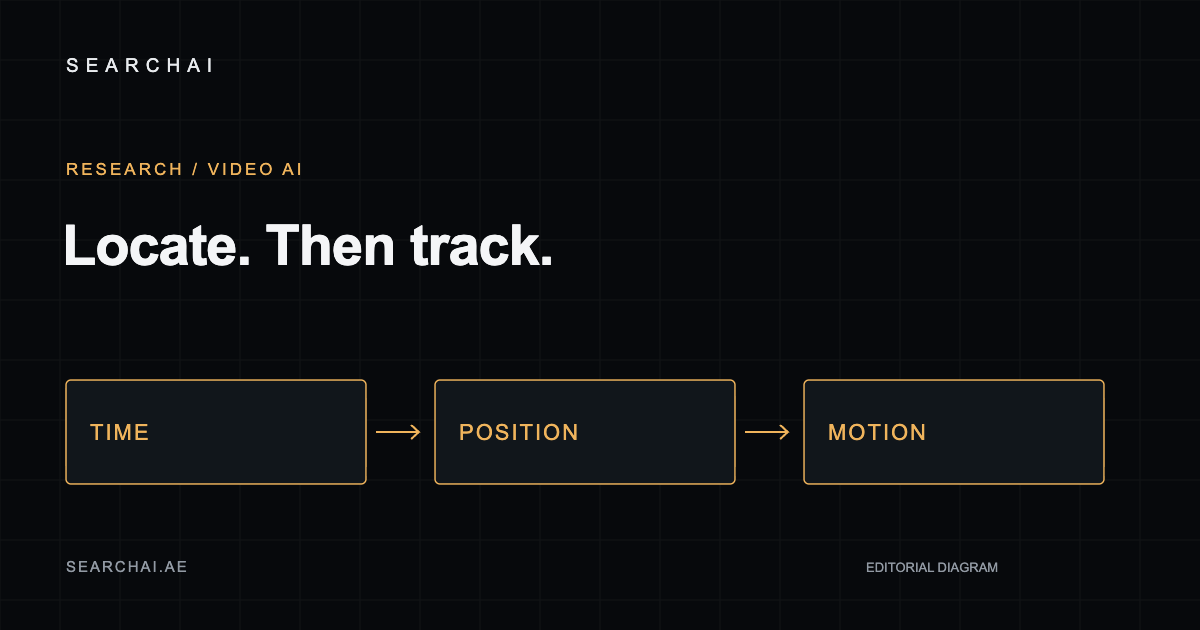
Research news. MBZUAI published an update on 6 October 2026 describing Parallel Tube Decoding, developed with UC Merced. The method tackles video grounding: identifying when an event occurs and locating the relevant object across that interval. Source: MBZUAI.
What the researchers reported
Instead of generating object positions sequentially, the approach first predicts the event interval and then predicts its bounding boxes in parallel. MBZUAI reports a VidSTG comparison in which trajectory completion fell from 31.6 seconds for the stated baseline to 0.4 seconds for PTD. These are the research team’s reported results; SearchAI has not reproduced the experiments.
What a product team should ask next
Our analysis: before turning a research result into a purchasing assumption, ask which part of your service consumes time. A video application may also involve upload, decoding, storage, retrieval and a user interface. A gain in one component should not be presented as the same gain for the complete service.
A useful evaluation would define the videos, target objects, hardware, acceptable localisation errors and end-to-end waiting time in advance. It should include difficult cases such as an object leaving the frame or a query that refers to something absent. Record failures alongside successful examples.
The practical question is whether the method solves the task under those conditions. It would be premature to promise a particular saving or customer outcome from the announcement alone.
For a reusable approach, see our guide to checking technology announcements and the evaluation worksheet.
Sources

AI-assisted technology coverage, explainers and practical guides. Sources and publication standards are described in our editorial policy.
All stories by this author