Key points
- Google does not require a special AI file for its search AI features.
- Track citations, visits and business outcomes separately.
Explainer. A useful AI-search strategy starts by separating documented requirements from tactics that have not been demonstrated on your own website.
What the documentation says
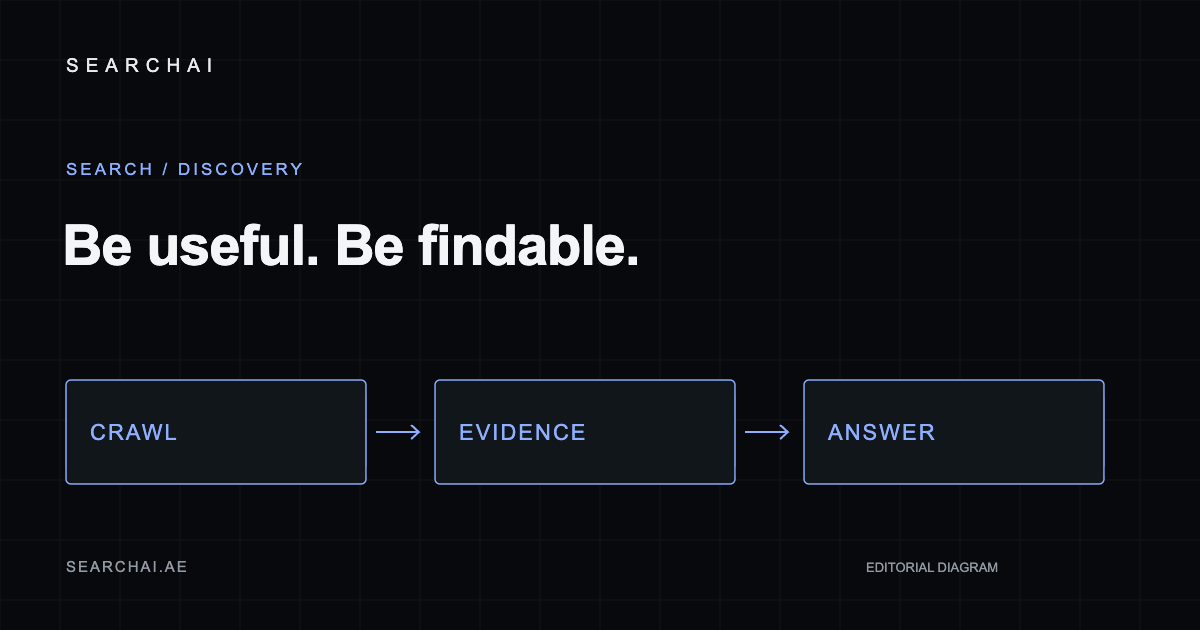
Google says its existing SEO practices remain relevant for AI Overviews and AI Mode. It does not require a special AI file or dedicated schema to appear in these features. A supporting page must be indexed and eligible to appear in Search with a snippet; meeting requirements does not guarantee inclusion. Google’s guidance for AI features is the primary reference.
A practical page audit
Choose one page that addresses a specific customer question. Check whether it can be crawled, whether its main explanation is readable as text, and whether its internal links make the surrounding subject easy to explore. Then ask a harder question: what can a reader learn here that is absent from a generic summary?
Useful additions might be a documented implementation, a comparison with explicit criteria or an explanation of when the proposed solution fails. Label examples as examples. Do not convert hypothetical savings into a customer success claim.
Measure discovery separately from business outcomes
Our suggested scorecard has separate rows for search visits, observed AI citations, referral visits and qualified enquiries. A citation is not a visit, and a visit is not a sale. Save the query, date and source whenever checking an AI answer; do not present a small sample as a universal ranking.
Run changes in limited batches so you can identify what changed. Avoid treating a new content format as successful simply because it produced more pages. For related measurement principles, see how to evaluate an AI pilot.
Sources

AI-assisted technology coverage, explainers and practical guides. Sources and publication standards are described in our editorial policy.
All stories by this author