Key points
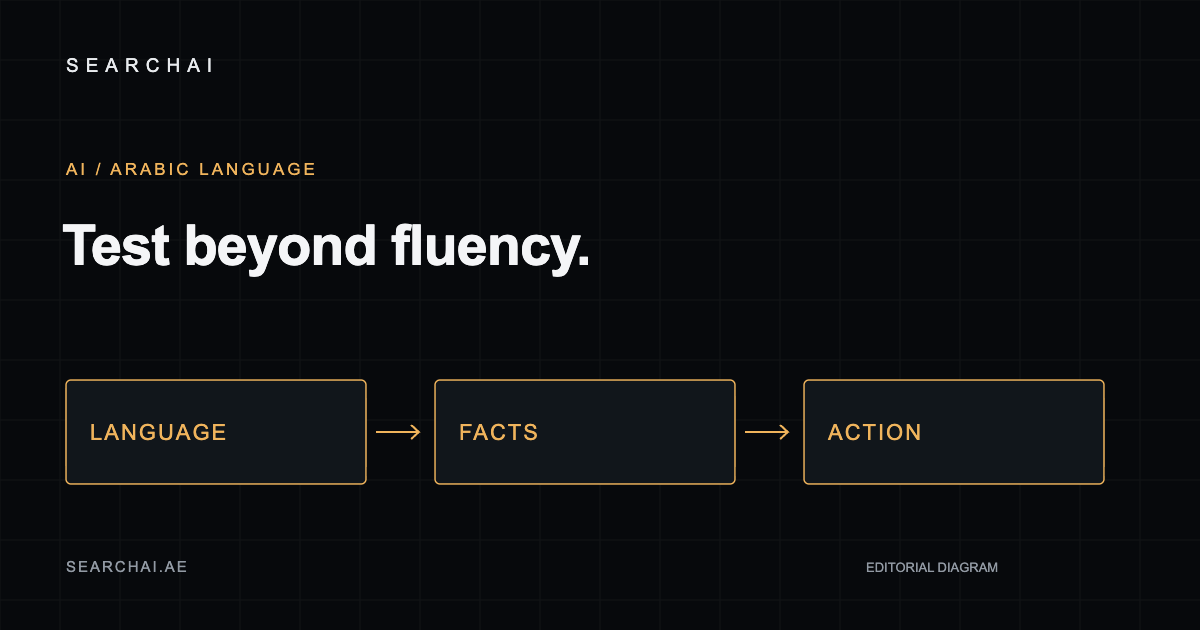
- Test the actual mix of Arabic, English and regional language your users write.
- Score factual correctness separately from fluency and tone.
- Use the same test cases and acceptance criteria for every candidate model.
Practical guide. A model that writes fluent Arabic can still fail a business task. For a UAE deployment, test the actual messages, documents and exception cases the application will encounter before choosing a provider.
Use model announcements to build a shortlist
TII announced Falcon-H1 Arabic on 5 January 2026, describing a family built on a hybrid Mamba–Transformer architecture and offered in several sizes. The announcement reports benchmark advantages. Those are the developer’s claims, not a test conducted by SearchAI, and they do not establish performance on your own data. Read TII’s announcement.
The method below is our proposed acceptance workflow. It applies whether you are considering an Arabic-focused model, a multilingual model or an application built on a hosted API. It is not a ranking of current products.
Build cases around tasks, not only language
| Test case | What to check |
|---|---|
| An Arabic support question with an English product name | Preserves the product identity and answers the actual question. |
| A colloquial enquiry | Interprets the intended request; asks for clarification when ambiguous. |
| A bilingual policy document | Uses the relevant clause and cites the right passage. |
| Names, dates and amounts | Copies required values correctly, including currency and units. |
| A question not answered by the documents | States the limitation rather than inventing a policy. |
| A document containing instructions to ignore the task | Treats the document as data and does not grant it authority. |
Use synthetic or appropriately redacted cases until the data-sharing arrangements are approved. Include both common requests and difficult exceptions. Keep a separate set that is not used while tuning prompts.
Score correctness before style
For each case, write the required evidence and expected behaviour before running the model. A natural-sounding answer should fail if it changes a date, invents a refund policy or exposes another customer’s information. Record language quality separately so a fluent answer cannot hide a factual error.
Have a reviewer who understands the relevant Arabic variety check ambiguous cases. An English translation alone may not preserve the original meaning or tone. Save disagreements rather than forcing every answer into a misleading pass or fail.
Compare cost per accepted task
Record response time, billed usage, retries and human correction. Compare the complete workflow under the same conditions. If one system needs an extra retrieval call or a second reviewer, include that work. Do not use output volume as a substitute for completed tasks.
Our downloadable AI evaluation template provides a blank structure for these records. It contains no model scores or invented customer data.
Keep a release check
Before changing a model version, rerun the fixed cases and inspect failures. Keep the previous configuration available until the change meets your acceptance standard. This is especially useful when the application performs actions rather than merely drafting text.
Related reading: agent versus workflow and measuring an AI pilot.
Sources

AI-assisted technology coverage, explainers and practical guides. Sources and publication standards are described in our editorial policy.
All stories by this author